Wednesday, March 31, 2010

Funeral Oration

During the American Civil War, after the battle of Gettysburg, the climax of the war, Abraham Lincoln gave his famous speech at the commemoration of the Field. His type of "funeral oration" is one of the most famous speeches in America to date starting with the phrase "four score and seven years ago" that is very known today. He gave this speeched at the consecration of Gettysburg where so many U.S. soldiers died. He believed that they should consecrate the field not only because so many died there, but for what they did die for, freedom. "...that from these honored dead we take increased devotion to that cause for which they gave the last full measure of devotion"(Lincoln). Another example of a funeral oration is the speech that Pericles gave at the funeral for the war dead, at the end of the first year of the Pelopennesian war. ("Pericles' Funeral Oration.") Pericles gave his speech and said that the Athenians that are still living should work for the cause that their dead die for. In both cases the speakers tell the living that they should not let the cause that the dead died for to rest.

Even though the speeches of Lincoln and Pericles are separate from each other they do share a certain link between them.

Honor was portrayed in each of these speeches. Honor was a major quality that was recognized in soldiers fighting in battle. In Lincoln's speech he declared, "It is rather for us to be here dedicated to the great task remaining before us…" (Lincoln). Lincoln praises the troops for being so dedicated to the war and fighting for the honor of their country. Pericles states that "…We have forced every sea and land to be the highway of our daring, and everywhere, whether for good, have left imperishable monuments behind us" (Pericles). Pericles explains that the soldiers would do anything for their country. Both Lincoln and Pericles honor their dead that have fought vigorously for their country.

Pride is the “pleasure or satisfaction taken in something done by or belonging to oneself or believed to reflect credit upon oneself.” (http://dictionary.reference.com/browse/pride) Both Pericles and Lincoln loved and were proud of their country. The pride that they felt toward their country is shown in their funeral orations. Pericles said "In short, I say that as a city we are the school of Hellas, while I doubt if the world can produce a man who, where he has only himself to depend upon, is equal to so many emergencies, and graced by so happy a versatility, as the Athenian. And that this is no mere boast thrown out for the occasion, but plain matter of fact, the power of the state acquired by these habits proves” (Pericles, http://www.fordham.edu/halsall/ancient/pericles-funeralspeech.html) Lincoln also shows the pride he felt toward his country in the funeral oration. Lincoln said “Four score and seven years ago our fathers brought forth on this continent a new nation, conceived in liberty and dedicated to the proposition that all men are created equal.” (Lincoln, http://odur.let.rug.nl/~usa/P/al16/speeches/gettys.htm) Lincoln is showing that the American people should be proud that they are a free country. Lincoln also talks about that the American people should be proud that they have liberties that other countries don’t have and that all men are created equal.

Patriotism is one of the key aspects needed for a country to grow to power and remain there for as long as time will allow. Many of the greatest leaders throughout history understood this concept of love and devotion to one’s country. They understood that they will have to suffer for the country to prevail. Both Lincoln and Pericles realized that for their country to survive they must utilize the concepts of patriotism. In Pericles’s funeral oration he said, “Such is the Athens for which these men, in the assertion of their resolve not to lose her, nobly fought and died; and well may every one of their survivors be ready to suffer in her cause” (Pericles). Pericles told everyone present for his speech of past events; that in order to not lose Athens to enemy forces the men had to produce unfathomable amounts of patriotism and died for their country. Now that they have already done that it is up to them to take the reins and suffer for the benefit of the great city. Lincoln, in his Gettysburg Address, also spoke of patriotism. He said, “We have come to dedicate a portion of that field as a final resting-place for those who here gave their lives that that nation might live” (Lincoln). Much like what Pericles had mentioned in his speech about death for advance Lincoln says also. Brave soldiers gave their lives, knowing that they must do so in order for their nation to stay above the clutches of their enemies. In the speeches of Lincoln and Pericles they both exemplified patriotism and how it can save a nation.

Although Abraham Lincoln and Pericles were separated by time, their funeral orations had a lot in common. The both gave speeches at a time of civil war, even though Athens and Sparta are not one they are joined by being Greek. Both speakers told their audiences they should not let the cause that their countrymen died for, be put to rest. They both spoke of how to have honor and pride to be patriotic. The link between Pericles and Lincoln is that they want their fellow countrymen to aid them in not letting the many deaths around them die in vain. Both Pericles and Lincoln believed in their countries and knew that the right words would help their fellow citizens to rise to the occasions surrounding them.

Works Cited

"Pericles' Funeral Oration." Wikipedia. Wikipedia, 11 Mar. 2010. Web. 29 Mar. 2010. <http://en.wikipedia.org/wiki/Pericles'_Funeral_Oration>.

"Pride". Dictionary.com. 3/31/10 http://dictionary.reference.com/browse/pride.

Lincoln, Abraham. "The Gettysburg Address". odur.let.rug.nl. 3/31/10 http://odur.let.rug.nl/~usa/P/al16/speeches/gettys.htm.

Group Outline

  1. During the American Civil War, after the battle of Gettysburg, the climax of the war, Abraham Lincoln gave his famous speech at the commemoration of the Field. His type of "funeral oration" is one of the most famous speeches in America to date starting with the phrase "four score and seven years ago" that is very known today. He gave this speeched at the consecration of Gettysburg where so many U.S. soldiers died. He believed that they should consecrate the field not only because so many died there, but for what they did die for, freedom. "...that from these honored dead we take increased devotion to that cause for which they gave the last full measure of devotion"(Lincoln). Another example of a funeral oration is the speech that Pericles gave at the funeral for the war dead, at the end of the first year of the Pelopennesian war. ("Pericles' Funeral Oration.") Pericles gave his speech and said that the Athenians that are still living should work for the cause that their dead die for. In both cases the speakers tell the living that they should not let the cause that the dead died for to rest.
    1. Thesis:

Even though the speeches of Lincoln and Pericles are separate from each other they do share a certain link between them.

  1. Honor
    1. "...we have forced every sea and land to be the highway of our daring, and everywhere, whether for evil or for good, have left imperishable monuments behind us." do anything for country (Pericles)
    2. "...that we here highly resolve that these dead shall not have died in vain…" (Lincoln)
    3. Both paragraphs honor the dead that have fought for their countries
    4. Both honor the country that they are a part of
  1. Pride
    1. "In short, I say that as a city we are the school of Hellas, while I doubt if the world can produce a man who, where he has only himself to depend upon, is equal to so many emergencies, and graced by so happy a versatility, as the Athenian. And that this is no mere boast thrown out for the occasion, but plain matter of fact, the power of the state acquired by these habits proves” “Pericles” (http://www.fordham.edu/halsall/ancient/pericles-funeralspeech.html)
    2. “Four score and seven years ago our fathers brought forth on this continent a new nation, conceived in liberty and dedicated to the proposition that all men are created equal.” “Lincoln” (http://odur.let.rug.nl/~usa/P/al16/speeches/gettys.htm
  1. Appeal to Patriotism
  1. “Such is the Athens for which these men, in the assertion of their resolve not to lose her, nobly fought and died; and well may every one of their survivors be ready to suffer in her cause.” “Pericles” (http://www.fordham.edu/halsall/ancient/pericles-funeralspeech.html)
  2. “We have come to dedicate a portion of that field as a final resting-place for those who here gave their lives that that nation might live.” “Lincoln” (http://odur.let.rug.nl/~usa/P/al16/speeches/gettys.htm)
V. Conclusion
a. restate thesis

Monday, March 29, 2010

Outline: Is there a link between Lincoln's Gettysburg address and the funeral oration of Pericles.

I. During the American Civil War, after the battle of Gettysburg, the climax of the war, Abraham Lincoln gave his famous speech at the commemoration of the Field. His type of "funeral oration" is one of the most famous speeches in America to date starting with the phrase "four score and seven years ago" that is very known today. He gave this speeched at the consecration of Gettysburg where so many U.S. soldiers died. He believed that they should consecrate the field not only because so many died there, but for what they did die for, freedom. "...that from these honored dead we take increased devotion to that cause for which they gave the last full measure of devotion"(Lincoln). Another example of a funeral oration is the speech that Pericles gave at the funeral for the war dead, at the end of the first year of the Pelopennesian war. ("Pericles' Funeral Oration.") Pericles gave his speech
citation:"Pericles' Funeral Oration." Wikipedia. Wikipedia, 11 Mar. 2010. Web. 29 Mar. 2010. .

Friday, March 26, 2010

Vikings vs England

  • the anglo-saxons were fighting the vikings
  • the vikings sent over 500 ships to England the
  • The English were led by Harold
  • the normans were led by William
  • the vikings were led by Harald Hardrada
  • Harold was afraid of the Normans who wanted to take over from the south, the Vikings wanted to take over near the north east. The Englishman set out to fight them at the Battle of Fulford which was the vikings vs the english september 1066. The vikings were led by Harald and the english were led by two earls
  • the vikings were not skilled in arrows but in hand to hand combat
  • http://www.carm.org/questions/about-sexuality/abortion-wrong

Thursday, March 25, 2010

where would rome be without the slaves

The Roman Empire’s rise to power is one of the greatest in history the backbone of the society was the plebeians and slaves; would Rome be the great empire it was without them? In Rome there were two main social classes, Plebeians and the Patricians. The plebes were the common folk and at first did not have much power but ended up fighting for it in the struggle of orders. The patricians were the wealthy aristocratic Romans who owned land and had a stronger hand in politics until the struggle of Orders. The struggle of orders is when the plebeians held and uprising against the Patricians for more power. The slaves though did not exactly have a choice to have an uprising. The slaves did the dirty work that took place in Rome so that the Romans could put their minds into other things. Without slavery Rome wouldn’t risen to power because they would have no backbone in their society.
In Rome, like most places, slaves were not treated well at all. The Romans knew that what they were doing was cold-hearted even a Roman playwright wrote of how slaves were treated. (Platus). As Rome grew and became more powerful more slaves were needed thus causing their masters to become more impersonal with them. Even Cato the Elder did not treat his slaves with Dignity. He believed they should only get new clothes about every two years and the food they got would be used. He said when they got new clothes they clothes that were taken away would be turned into sacks which shows how bad the clothes were. (Cato the Elder). When the slaves revolted there was much turmoil in Rome which shows how important the slaves where. It took a lot of power from the Roman government to get them to calm down. The revolt of the slaves caused much fear as the stoic Romans were afraid that if they slaves took over all they would do was destroy everything. It seems that every time the slaves revolted the Romans could handle it but were still scared out of their wits by them.
The slaves tried many times to revolt, and as the Romans thought them dull minded they were quite clever. Sicily, which was under the power of the Romans, had been bringing in a lot of slaves. There is large problem with bringing in many slaves, there were more slaves than plebeians and patricians. During the Servile Orders two different slaves created two different groups to rampage against those in charge. Although the governors and such believed that the two different groups would end up killing each other the two groups joined forces. (Diodorus Siculus). There was a sicilian slave named Eunus who led one group, he was appointed king and after he and his slaves wiped out basically everyone except for those who could make them weapons. He and his “army” battled Roman generals and beat them very often. The slaves themselves were often used in war. The other slave who led the other group had the name of Cleon. As the war went on the slaves had almost 200,000, by far outnumbering the Romans. In the end the rebels ended up being caught and put under horrible circumstances such as eating their children.
The slaves were strong minded and the Romans learned slowly but surely to treat them with dignity because without the slaves they had much strife. If the Romans did not depend so dearly on their slaves they would not have had so much trouble, and without them they would still be great. (Joel Madden). The fact of the matter is the Romans depended entirely to much on the people that they treated horribly. They got ahead of themselves and did not realize just how many slaves there were.
Without the slaves Rome would not have gotten as much power as it did. If the Romans had to worry about their agriculture, and house duties, and keeping Rome clean, they would not have time to be out conquering more land. Many of the slaves were also soldiers and without all of the soldiers there is no possible way that Rome would have conquered so much land and become so powerful.
"Rome." Ancient History Sourcebook. Ed. Paul Hallsall. Fordham Edu. Web. 25 Mar. 2010. .

Friday, March 19, 2010

Who is the good guy and who is the bad guy


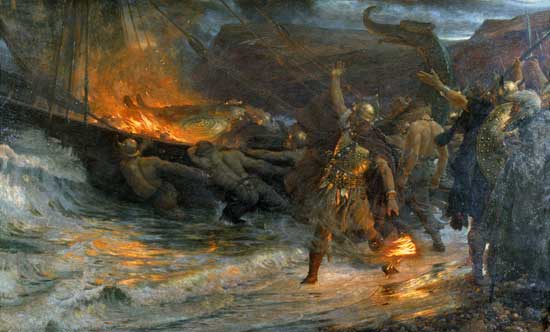
Who is a good guy and who is a bad guy? In the past you would think of a bad guy as the mean one who causes sadness and destruction. Today in the media it is the same thing except with a twist. The media looks at people who are the “bad guy” and tries to figure out why they are “bad”. In novels the author sometimes tries to explain how the “bad guy” got to be the way they are. It is almost as if today we are trying to justify why people are bad, but also why they are good. If you close your eyes and think about Vikings, what do you see? You picture a large man with a hat which has horns on it. You think of someone who pillages towns and kills innocent men, women, and children. You think of a bad guy. But were the Vikings really the bad guy? To answer this question figuring out why they pillaged and killed would be necessary. Also you would have to figure out who is the good guy?

Vikings are popularly known as men who would invade towns in Ireland, Britain, and other places and take as much as possible. Viking in Norse even means piracy (Abkar, Arifa). Some scholars are even feuding over whether or not the Vikings were pillagers. These scholars are saying that the Vikings were not indeed mass murderers and thieves but a good example of cultivated pilgrims, who set the standard for settlers after them. Arifa Abkar writes about this in her article titled, The Vikings: It wasn’t all raping and Pillaging, found in The Independent (http://www.independent.co.uk/news/uk/this-britain/the-vikings-it-wasnt-all-raping-and-pillaging-1643969.html). If word gets out that in fact the Vikings were not so vicious then they will probably be seen as the “good guys” since according to the article the Vikings actually got a long quite well with the Celts and British people. If this is so, how come the picture of the Vikings today has come to be so? Scholars view this as the fact that after the renaissance of Scandinavia, Irish story tellers portrayed the Vikings as invaders who destroyed everything in their path. It is true that some Vikings did parade over the British Isles and pillage and kill innocent people, but that’s not what goes to say for all of them. If that is truly the case then wouldn’t these Irish story tellers be the “bad guys”?

For the Vikings that did pillage you may want to know why the pillaged, to see if they are truly bad. During that time in history many civilizations would invade countries so that they could take over and gain power. With the Vikings, who pillaged, that does not seem to be the case. Vikings would just steal, and stealing is a serious taboo today, just as it was in the past. Some scholars say that the reason the Vikings left their cold and barren home in Scandinavia was because living in such harsh conditions was hurting them. They moved south the only way they knew how, on boats. As there is no clearly stated reason that the Vikings left explaining why they became such vicious marauders, scholars agree that the reason is probably the fact that they were poor and slowly losing space in their homeland. The Scandinavians were growing high in numbers but the land was not growing with them. They already knew that their southern neighbors were rich in wealth and land so they decided to leave their home and south. Many of the first vikings who left, left because as political beings were taking over in their homeland they had no power anymore. They viking leaders would take their families and leave. The first known place that the vikings attacked is called Lindisfarne, located in the British Isles. The site were they attacked was a monastery, the vikings stole the church's treasury and killed many of the monks. This is just one of the reasons that vikings are seen as bad guys. Another reason is that most of the places attacked by these vikings were small and unprotected like churches, farms, and small villages.

The Vikings seemed to gain power from weak societies. Whenever they were met with a place that had a strong fort or was protected by soldiers they would tend to go back to their jobs as traders. Using their strength they found a way to get good cash. The head of certain towns would have taxes set aside that would go to the vikings and in return the vikings would not attack them. The vikings seem to not want that much trouble and in a world were Christianity was very much in charge, when the vikings started to live with the southerners they would convert.

It seems that the Vikings cannot be classified as good or bad. They are bad because many of them took lives and stole. They are good because they eventually stopped and worked well with their peers. The vikings felt as if they had no way out to live a better life. The men wanted to have an easier life and felt that having more money and power would get them that. Even though they felt they had no way out, The Vikings are the "bad guys" because what they did was still wrong. Although they contributed a lot to present UK, they were the bad guys.


Citation: Abkar, Arifa. "The Vikings: It Wasn't All Raping and Pillaging." The Independent [London] 13 Mar. 2009. The Independent. 13 Mar. 2009. Web. 19 Mar. 2010. http://www.independent.co.uk/news/uk/this-britain/the-vikings-it-wasnt-all-raping-and-pillaging-1643969.html.

Rosenthal, Joel T. "Vikings." Microsoft® Student 2009 [DVD]. Redmond, WA: Microsoft Corporation, 2008.

"Viking Funeral." commons wikimedia. Web. 19 Mar 2010. .

Thursday, March 18, 2010

Three examples of Charlemagne's influence in the architecture or literature of the Early Middle Ages

Charlemagne, a.k.a. Charles the Great, he was a great political leader in the 8th and 9th century and ruled the Western Empire Of Europe. Charlemagne was good when it came to speaking, which showed he had charisma. During the Byzantine era, rulers began to notice that if you had religion, the Church, on your side than you would be very strong. Charlemagne was very religious and added to the Church's treasury by filling it with gold, silver, and jewels. He sent a lot of gifts to the popes. Charlemagne wanted to make St Peter's church the best and he wanted to put have the Church in Rome under his influence so he could make it better. When he crowned king by the Pope in 800 his influence in architecture and literature became apparent in the Middle Ages.
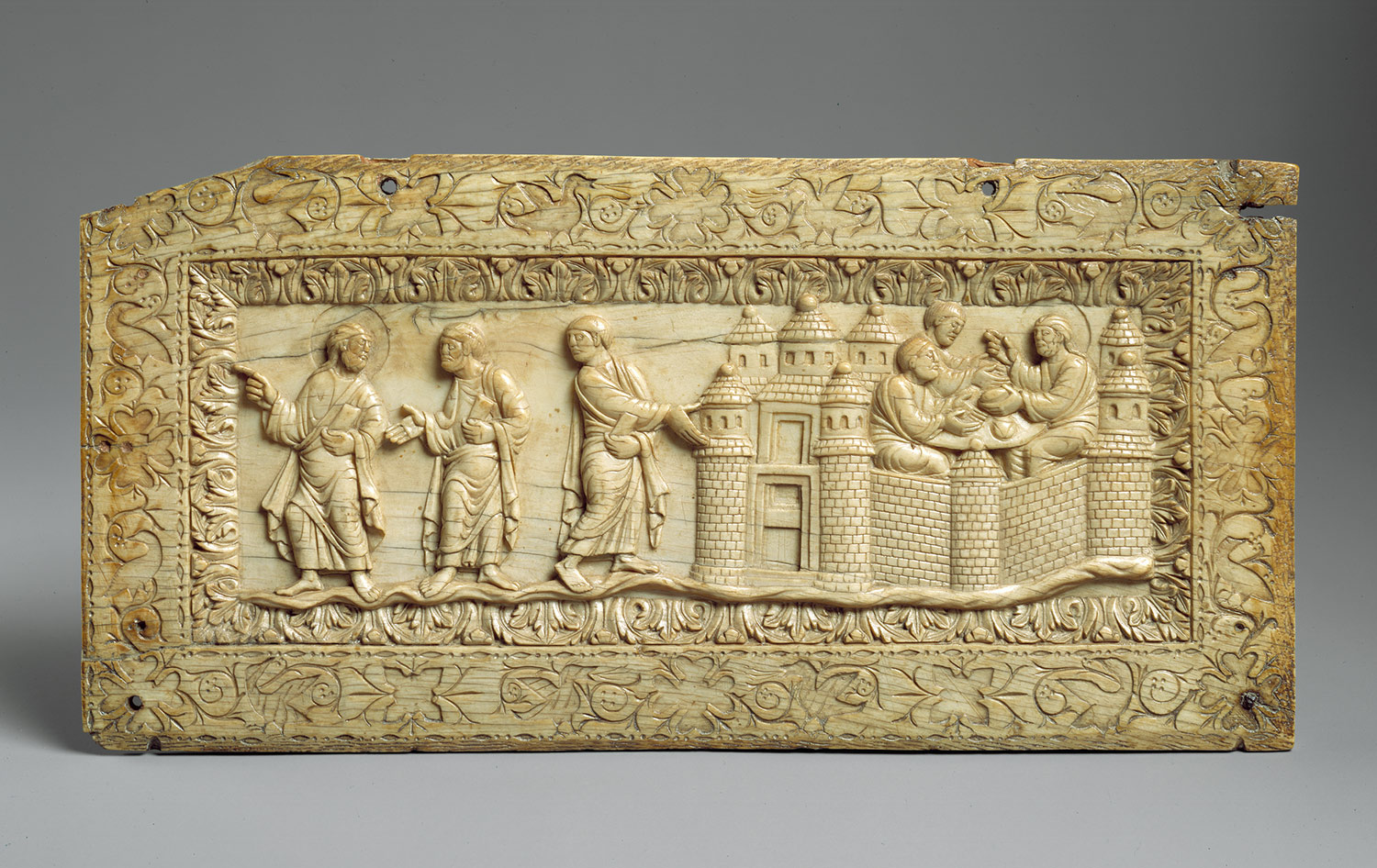
The Caroliginian Renaissance refers to the time of a certain type of culture that arose when Charlemagne became ruler. Charles was so into latin that he had many writers write in latin. Before Charlemagne was in charge the people had a lot of metal in their art, he merely added on to that. The picture below is the story of Christ's supper. You can tell it is from the Carolginian era because of how full of life the figures are.


Charlemagne also had a large effect on the architecture of his time. Charlemagne respected the greatness that Rome had and wanted to mirror that. The architecture of that time imitated Roman architecture but also had hints of Early Christian architecture and the architecture from the Byzantine era. All of these elements added together ended up in a very distinctive type of construction. A good example of the mix of these different cultures would be the Palatine Chapel in Aachen. It has hints of the Byzantine era when Justinian ruled because of its shape, octagonal, like the Justinian church in Ravenna. The touch of Carolingian can be seen in one of the entrances that is colossal. It is an idea from the Carolingian time called "westwork." "A westwork (also westwerk, the German word) is the monumental, west-facing entrance section of a Carolingian, Ottonian, or Romanesque church.

The exterior consists of multiple storeys between two towers. The interior includes an entrance vestibule, a chapel and a series of galleries overlooking the nave."("Westwork").


In the art of that day, especially in manuscripts, you would find that much of the art are depictions of the old testament. The covers of these manuscripts would be covered in gold and precious jewels and stones. The panels would be set by ivory.


citation:"Plaque with Emmaus Scenes [French] (1970.324.1)". In Heilbrunn Timeline of Art History. New York: The Metropolitan Museum of Art, 2000 ndash;.
http://www.metmuseum.org/toah/ho/06/euwf/ho_1970.324.1.htm (September 2009)

Drogo Sacramentary. Digital image. Wikipedia. Wikipedia. Web. 18 Mar. 2010. .
Plaque with Emmaus Scenes. Digital image. Metropolitan Museum of Art. MetMueseum. Web. 18 Mar. 2010. .
Sorrebela, Jean. "Carolingian Art." Metropolitan Museum of Art. MetMueseum. Web. 18 Mar. 2010. .
"Westwork." Westwork. Wikipedia. Wikipedia. Web. 18 Mar. 2010. .