Friday, May 28, 2010

Blurbs

Pausanias: Description of Greece
  • One of the first things that you see when entering Attica is the temple to Athena. Peiraeus is the port of Athens and there is a lot of history behind it, it is believed that is where Menestheus left to go destroy Troy. There are monuments to Zeus and Athena in Periaeus also, they are both bronze statues. Near a portico by the see is another monument to Zeus and Demos. By the other see Canon is the sanctuary of Aphrodite. At another harbor called Munchyia the Athenians have many sanctuaries and shrines to gods and heroes alike. In the city of Athens itself there is another monument to Antiope, an amazon woman shot because of a love triangle she was enthralled in. Moving up from Peiraeus is a road and on the side of the road are graves of famous men who had fought in wars. The city is a perfect depiction of being wary of the gods because it is basically a shrine to them. Many of the memorable places in Athens have a story behind them that can be told a number of ways. Pausanius likes to give the back stories on basically everything in Athens because it gives these different places character and it shows their history.
Plutarch
  • Solon's father is considered to be Euphorion more people agree that it is Execestides. His mother is related to Pisisastrus's mother making Pisisastrus and Solon Cousins. Plutarch says this is why Solon and Pisisastrus never really fought even though they had heated arguments in government. Plutarch likes to give quotes to prove his statements true. Plutarch likes to explain all angles of the person he is writing about even the people that in this case, Solon met. This way he does not leave anything open and everything is explained.
Solon
  • Solon wrote of everything that he did in career. The way he wrote it down was very poetic, he wrote of how he freed many Athenians from slavery. Solon was a strong Athenian and all for his city. He was a patriotic person.
Herodotus
  • Herodotus wrote of how politics, no matter how perfect they seem, have flaws and when people gain to much power it goes to their heads. Herodotus's writing seems almost poetic and it flows so that although what your reading is true it seems like a story is being told.
Pericles
  • In Pericle's Funeral Oration he is writing to bring patriotism to the Athenians and showing that all the pain that many of them have gone through is not in vain.

Thursday, May 27, 2010

Out line: How do you think things would have been different if the Persians had won the Persian wars?

  1. How do you think things would have been different if the Persians had won the Persian wars?
    1. Thesis: The spread of Greek philosophy and culture would have been halted if the Persians had won the Persian wars.
  2. The Fathers of History
    1. Aristotle's works would be completely different if there would be any at all, his life experiences would be totally different if the Persians had taken over his country. If Aristotle's works were not published than England would never have had the 12 century renaissance that they had when they discovered his works.
  3. Alexander
  4. Alexander would have had a harder time taking over Persia, his teacher probably would not have been Aristotle. Alexander may not even have been in the power he had.
  5. Acropolis/Athens
1. If the Persians had won the war then the Acropolis in Athens would never have been rebuilt. The Romans would probably have not as easily took control of Athens later on either.
2. Athens probably would not have become the greatest Greek trading place which is what happened after the Athenians came back to Athens and rebuilt their city. "Athens thus became the finest trade centre in Greece." (Ancient History Sourcebook)
6. Greece
1. Greece would be totally different than it is today because the Persians would have basically eliminated all traces of the Greek culture or would have molded it to fit Persian culture.
2. When the Persians had lost the first invasion of Greece, Athens was still in fear that the still powerful Persians would attempt to invade Greece again. They and other allies formed the Delian League. The Delian League was a democratic alliance much like the United Nations today. If the Persians had won the wars than the Delian League would not have been formed. "They are the first two examples of which we have detailed knwoedlge of a serious attempt at united action on the part ofa large number of selfgoverning states at a relatively high level of conscious political development."
7. Conclusion
1. The world as we know it would not be the same if the Persians had won the Persion invasion. Such philosophies such as that of Aristotle would not exist and European culture would have reached its renaissance, if it did at all, much later than it did.
8. Citation
"Ancient History Sourcebook: 11th Brittanica: Delian League." FORDHAM.EDU. Web. 28 May 2010. .
"Ancient History Sourcebook: 11th Brittanica: Themistocles." FORDHAM.EDU. Web. 28 May 2010. .


Reviewing: Egypt and Greece

  • In the Egyptian after life, whether or not a person went to the underworld had a lot to do with the ka. The ka was a person's soul and they would have their heart measured against a feather of mot. If it was lighter than the feather it could go into the afterlife with Osiris Isis and their names were entered in the book of the dead.
  • 6 major historians
  • Herodatus (490-525 BCE) - Persian wars between Greeks and Persians
  • Thucydides (460/455-399BCE)- Pelopenisian wars Spartans Athenians
  • Xenophon (428-354)- Athenian wrote about what happended during Socrates time
  • Aristotle (384-323BCE) - logic and philosophy, wrote the first encyclopedia and had his students at his school help. Encyclopedia in Greek basically means encompasses all learning.
  • Plutarch (46-120CE)- Greek lived during Roman occupation. Known for his biographies
  • Pausanias (fl. 160CE)-wrote first travel guide
  • Classical age started around 400 BCE with the Greeks coming out of the archaeic age.
  • Persian Wars
  • Xerxes worked his way up the coast and asked people to join him or be destroyed, some Greek city states joined him while others got destroyed. The bosphorus is also known as the Istanbul Straight. The went through Thrace, Macedonia, Thessaly, Epirus and then to Attica. For a while they were stopped at Thermopylae where the Spartans and some of their allies held them off so that Athens could be evacuated. The Harbor of Athens is called Piraeus it was the port of Athens and it had large walls that protected them from attacks.
  • Greek Geography. When the Persians got their and the city was gone they burned everything including the things on the Acropolis. When the Persians were lured out to and defeated at Salamis the Athens returned and rebuilt the Acropolis and formed the Delian league and they used the money from the league treasury to rebuild the Acropolis.
  • Thessalonika is also called Thrace, it is in the Northern Region of Greece
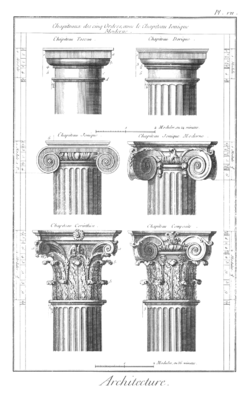
  • The Acropolis has a history of war and religion. During the persian wars it was destroyed and it had the theater of Dionysus, a goddess. The Parthenon is on top of the Acropolis and it is the most important piece of Doric Architecture which is the oldest type of Architecture in Greece.

Thursday, May 20, 2010

What were Michelangelo's influences? Consider his works in fresco, sculpture, architecture, poetry and underlying humanist beliefs?


Even at birth Michelangelo was constantly surrounded by art. His birthday, March 6th was considered astrologically the time of being a genius of the arts. Even before Michelangelo could walk he was supposed to be great with art. His father, Lodovico di Lionardo Buonarotti Simon, ended up moving himself and Michelangelo to Settigano in Florence where there were many sculptures working. The constant art in his life is one of the influences on Michelangelo's intrest and perfection in his art. "Giorgio, if I have anything of genius, it came to me from being born in the subtle air of your country of Arezzo, while from my nurse I got the chisel and hammer with which I make my figures. (Michelangelo).
Michelangelo eventually came to be schooled under the Medici who had an art school. Lorenzo Medici was so interested in Michelangelo's work that he begged Buonarotti's father to adopt him Michelangelo grew up with the Medici and loved them a lot, during the protestant reformation on Pope Clement's death bed, Michelangelo was asked to finish his work in the Sistine chapel. He did this and he portrayed his mood into the final painting of the last judgement. The Medici were a great influence on Michelangelo's work because they were the ones who paid for his education in art.
Another great influence on Michelangelo's work was his belief in humanism.
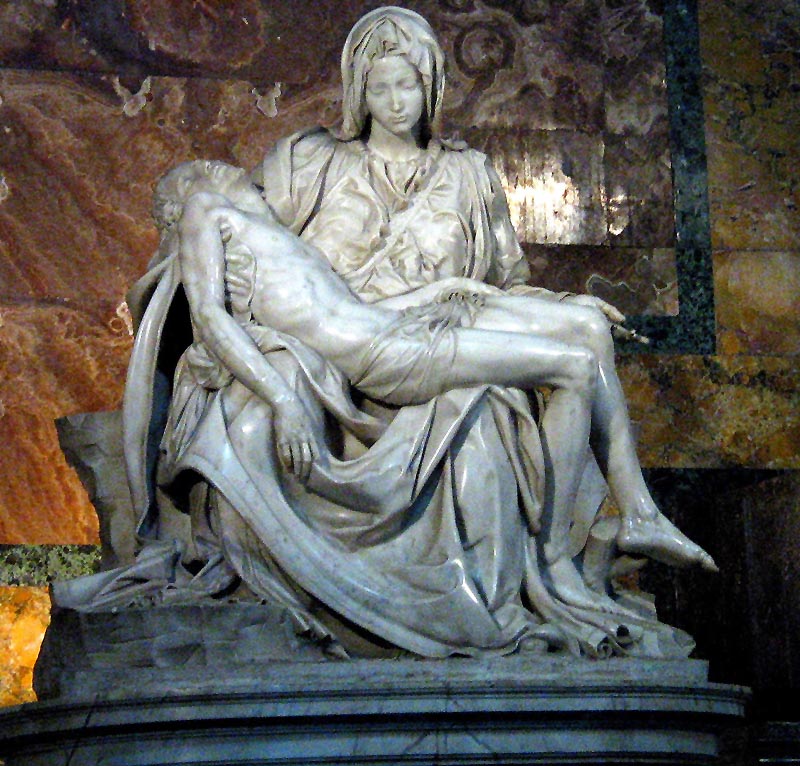
Humanism is the philosophy of a variety of ethical theory and practices that emphasizes a reason, scientific inquiry, and human fulfillment in the natural world and often rejects the importance of belief in God (Dictionary.com). Humanism during the Renaissance or Michelangelo's time was more about separating from God and understanding the human mind more. This is spotted in his sculpting and painting because his depiction of Holy things were all in Human form and were not made to look any different from regular human beings.
During the time where art was starting to seem more pagan with such artists as Sandro Boticelli painting the birth of venus, Michelangelo was pushed even closer to the Church. He ended up working closely with the church for which he painted the Sistine Chapel, and for Pope Leo, a Medici, he built tombs for the Pope's father.
In Michelangelo's poem he wrote of love, drew images, and started to write about Christianity. He showed sorrow in his later poems so it seemed he regretted something. Michelangelo was a steadfast praiser of the Lord and this not only came out in his art but in his poetry. "No man can find it: Father! Thou must lead". (Michelangelo)
Michelangelo's influences were God, the art that surrounded him as a child, and the Medici.
Citation:Creation_of_Adam_Michelangelo. Digital image. Commons Wikimedia. Wikipedia. Web. 20 May 2010. .
"Michelangelo Biography - Life, Family, Childhood, Death, Mother, Young, Son, Old, Information, Born, House, Time, Year." Encyclopedia of World Biography. Web. 20 May 2010. .
"MICHELANGELO BUONARROTI(1475~1564." Oracle ThinkQuest Library. Web. 20 May 2010. .
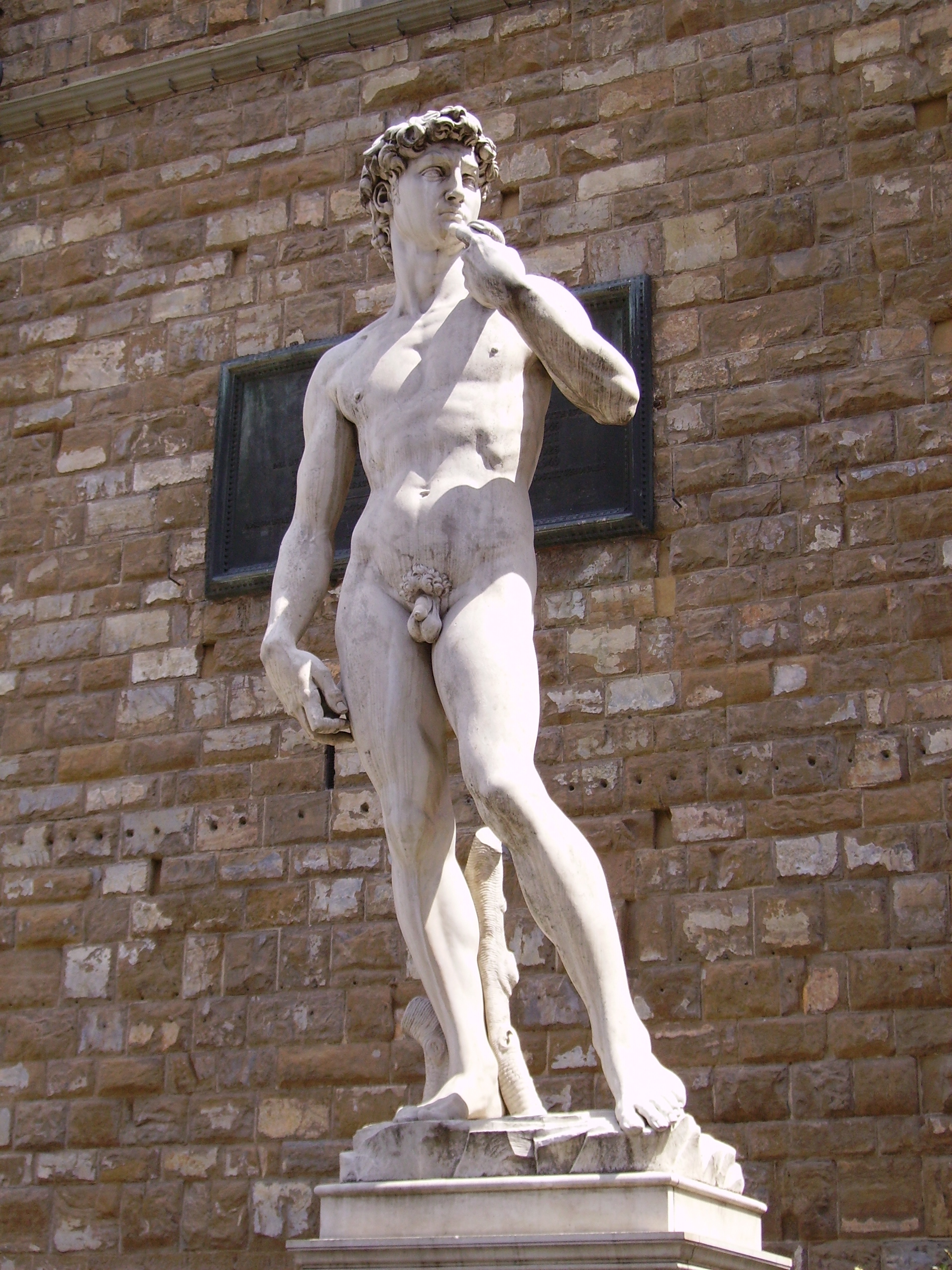
Michelangelo-Buonarroti-David-2-Replica-Florence. Digital image. Commons Wikimedia. Wikipedia. Web. 20 May 2010. .
Michelangelo_Petersdom_Pieta. Digital image. Commons Wikimedia. Wikipedia. Web. 20 May 2010. .
"To the Supreme Being, by Michelangelo Buonarroti." Poetry Archive | Poems. Poetry Archive. Web. 20 May 2010. .
Vasarie, Giorgio. "Michelangelo: Giorgio Vasari's Lives of the Artists." FORDHAM.EDU. Web. 20 May 2010. .

Notes on Micheal angelo and Medici

  • 1501
  • Michael angelo sculpted a 13 foot marble block. He worked very hard and his life was all about art. It took him three years to finish the block
  • He started to draw away from the Medici.
  • When Florence came away from the Medici the Medici fled Florence while Michelangelo stayed. The cousin Medici, Giovanni and Guliano were trying to make it big in the church but they could not without Florence, where they could not return. They went throughout Italy trying to get the help of friends.
  • When Michelangelo was finished his sculpture it was unveiled to Florence, it was first meant to go onto the Cathedral but they put it front of the town hall. The sculpture it was David but when placed in front of the government building it became a symbol of the city. He was upset that the Medici did not help Florence in the way he wanted.
  • One of Michelangelo's competitors was da Vinci who even went to such great lengths as dissecting human bodies.
  • Niccolo Machievelli had to protect Florence from the Medici and he formed an army against them. The Medici ended up gaining control of the city but the people still did not like them. Giovanni was a cardinal and when the pope died he became Pope Leo the tenth. When Giovanni became Pope, Florence forgot everything and took the Medici in with open hands and appointed Gulianno archbishop and eventually cardinal.
  • Michelangelo was already commisioned to paint the ceiling of the Sistine Chapel by the late pope and he thought he would fail.
  • Michelangelo worked with Fresco which was very hard to work with because it had to be painted on quickly. The Medici who were now in charge offered Michelangelo to bring tombs for their fathers. Machievelli was eventually exiled from Florence. Machievelli wrote a book called the Prince and it seperated politics from thinking he believed he would be able to get on the good side of the Medici and it failed.
  • 1516, some cardinals conspired to assassinate the pope he had been warned previously and had them killed after a failed attempt. The Medici ended up being more careful about who they let in power.
  • Pope Leo eventually owed a lot of money and his cousin was pawning away the pope's jewel. Pope Leo started to sell papers that said if a person had done wrong they had the Church on their side. These were called indulgences. Martin Luther became angry at the church for this. He wrote a "manifesto" for change and had many versions of it printed and circulated. Luther was trying to reform the Church but things lost control. Pope Leo saw this and condemned Luther to hell. Luther started the protestant reformation and the Church split in two. When Leo the tenth died his cousin Julio had to deal with the problem of protestant reform and he became Pope. The protestant reformation brought fighting into Rome. The Pope fled to Florenc but the rioters found out already and sacked Florence including break the David that michelangelo had created. Michelangelo hid in a church.
  • Catherine de Medici was in line if Clement died. She was 7 years old and the people threatened to throw her into a soldier's brothel and he called of his troops so they could rescue her. Catherine was married of at 14 to the son of the French King. The religious wars soon affected France because of her. Pope Clement was eventually on his dying bed and he asked Michelangelo to make a fresco for him. Michelangelo painted the last judgement. He died in 1534 ending the corrupt reign of Medici popes.

Friday, May 14, 2010

Is Monarchy more or less effective than democracy?


When a person thinks of a Monarchy they think of Kings and Queens and such. Today the most famous Monarchy is the Monarchy in England. What most people do not know is that the Queen of England does not do much to do with legislature and is more of a figure to unite the nation. Look back at Monarchy of the Renaissance and the Middle Ages, when Monarchs had real power. Monarchs were very effective when it came to getting what they wanted for their country. Democracy is the type of government in the United States, it is also effective but it takes longer when it comes to legislature because more people have to be pleased. Monarchy is more effective when it comes to making changes because it does not go through series of process where there are a lot of people that have to deem something good or not.
The American government has a system called a democracy. A democracy is government by the people; a form of government in which the supreme power is vested in the people and exercised directly by them or by their elected agents under a free electoral system.(Dictionary.com) Having a law past in America can go from a couple of months, to a couple of years because of all the people that have to agree to getting the law passed. The government is comprised of the system called checks and balances so that no one has to much power. Checks and balances are limits imposed on all branches of a government by vesting in each branch the right to amend or void those acts of another that fall within its purview (Dictionary.com). The American government is effective but not as effective as absolute monarchy.
A Monarchy is a state or nation in which the supreme power is actually or nominally lodged in a monarch (Dictionary.com) So basically the person who is the monarch has supreme power and is considered "sovereign". There are two types of monarchy, absolute monarchy and limited monarchy. Absolute monarchy is a monarchy that is not limited or restrained by laws or a constitution (Dictionary.com). Limited Monarchy is a monarchy that is limited by laws of a constitution (Dictionary.com). The Monarchy that the Tudor Dynasty belonged to was an absolute monarchy and England was ruled with monarchies such as these until after parliament took a change around the time of Edward VI. The most famous Monarchy today is the Monarchy in England. The monarchy that England has today is a limited monarchy. Today's English Monarchy is more of a promotion of National Unity. They are more for show because they mostly go to events and carry out important deeds and charity. The monarchs of England today are called constitutional monarchs. When the constitution of England was formed around 1688 the monarchs lost a bit more of power. Walter Bagehot was a wealthy englishman who wrote about the English Constituion. He wrote about the English Monarchy and said that the "Sovereign" have three rights which are: "the right to be consulted, the right to encourage, the right to warn" (History and Background).
Laws in older England, when Monarchs had more power, did not take very long to get passed. The more trouble was making sure everyone in the country new the law. A good example of this is the reign of the Tudor monarchs. In a true monarchy, the king or queen rules everything and has a set of advisors. Laws can be made very quickly and only needed the yes or no of the monarch. One of the main problems with the monarchy of the Tudor times is that the power would sometime go to their heads and they would ignore the plight of their people. Such as Queen Mary who turned the Protestant England back to Roman Catholicism and persecuted Protestants in England. In her persecutions about 800 wealthy protestants exiled themselves from England, and 284 were executed. One of the main problems with absolute monarchy is that when monarchs change there is a possibility of having a very different monarch, which is what happened with the Tudors. Henry VIII was for England being Protestant, as was his son. Then Mary changed England to being under Rome's rule but when Elizabeth changed England back to being Protestant. Monarchs are very quick when it comes to changing things they do not like where as in a democracy it would take a longer time to get change.
There is a large difference between what is more effective and what is better. Democracy is better because the people of a country have more input into what happens with their rights and laws. The chance of an uprising occurring in a democratic government is not as high as an uprising happening in a Monarch ruled government.
Monarchy is more effective than government because there is not such as hassle for legislation like there is in a democracy. Although a democracy is all around better than a monarchy Monarchs have more effect.
citation: "The Act of Supremacy." Then Again. . . Web. 15 May 2010. http://www.thenagain.info/Classes/Sources/ActSupremacy.html
"BBC - History - British History in Depth: Wales under the Tudors." BBC - Homepage. Web. 15 May 2010. http://www.bbc.co.uk/history/british/tudors/wales_tudors_01.shtml
Courage, Despite Her. "Mary I of England." Wikipedia, the Free Encyclopedia. Web. 15 May 2010. http://en.wikipedia.org/wiki/Mary_I_of_England#Persecutions
Elizabeth_I_of_England. Digital image. Commons.wikimedia.org. Web. 14 May 2010. http://upload.wikimedia.org/wikipedia/commons/a/af/Elizabeth_I_of_England_-_coronation_portrait.jpg
"Elizabeth's Act of Uniformity (1559)." History Department, Hanover College. Web. 15 May 2010. http://history.hanover.edu/texts/engref/er80.html
"History of the Monarchy." The Official Site of the British Monarchy. British Monarchy. Web. 14 May 2010. .
"Monarchy of the United Kingdom." Wikipedia, the Free Encyclopedia. Web. 15 May 2010. http://en.wikipedia.org/wiki/English_monarchy#Constituional_role
"Parliament of England." Wikipedia, the Free Encyclopedia. Wikipedia. Web. 15 May 2010. http://en.wikipedia.org/wiki/Parliament_of_England
"Tudor Dynasty." Wikipedia, the Free Encyclopedia. Web. 14 May 2010. http://en.wikipedia.org/wiki/Tudor_Dynasty#Tudor_monarchs_of_England

Martin Luther video

  • The Church was in charge and could sometimes be corrupt and act like tyrants
  • Martin Luther grew up in Northern Germany as a child he worked in the church which he found as an escape from his home. His parents beat him and his father wanted him to be a lawyer but they were lower than that on the chain.
  • Luther went to the best schools and enrolled at the university of Erfert.
  • In 1505 the plague hit Erfert and three of his friends died of it. He began to greatly fear and revere God. One night he was stuck outside in a storm and almost died and he took a vow to become a monk.
  • He became a monk and the monastery which he lived in was quite nice because it was very business like. The Church got taxes from the people who gave them this willingly for fear of being cut off from God. This eventually drew Luther away. The Monks would go threw a lot of self mutilation like whipping and even Luther slept out in the snow until he was pulled inside.
  • Luther eventually went on a pilgrimage to the Holy City if Rome, when the Renaisance was reaching its peak. When the shine wore off Luther noticed the Church was more about money. He began to notice that the priests were only good business men and did not care at all about God.
  • Luther started to question the teachings of the Church. Luther began to confess many times over because everytime he confessed his inner conscience would tell him how not sorry he really was.
  • He ended up going to work with another monk who made him work with the spiritually uncertain